

Costs and pricing
Part of The full cost of grants, debt and equity for women founders, time included
Pricing women founder funding support, from fixed fees to contingent and equity
Compare fixed, hourly, contingent, subscription, debt and equity pricing for women founder funding support in England on consistent terms and evidence.
Pricing for funding support usually falls into fixed, hourly, contingent, subscription, debt or equity models. None is automatically best. Compare the same defined job, risk and period, then inspect what the headline excludes.
What to take away
- Add every fee layer, including setup, monthly access and success charges, before comparing.
- Equity needs a cap-table scenario, not an interest calculation, to show ownership and rights.
- Model failed processes, as fixed and time-based work can be payable without an award.
A like-for-like comparison
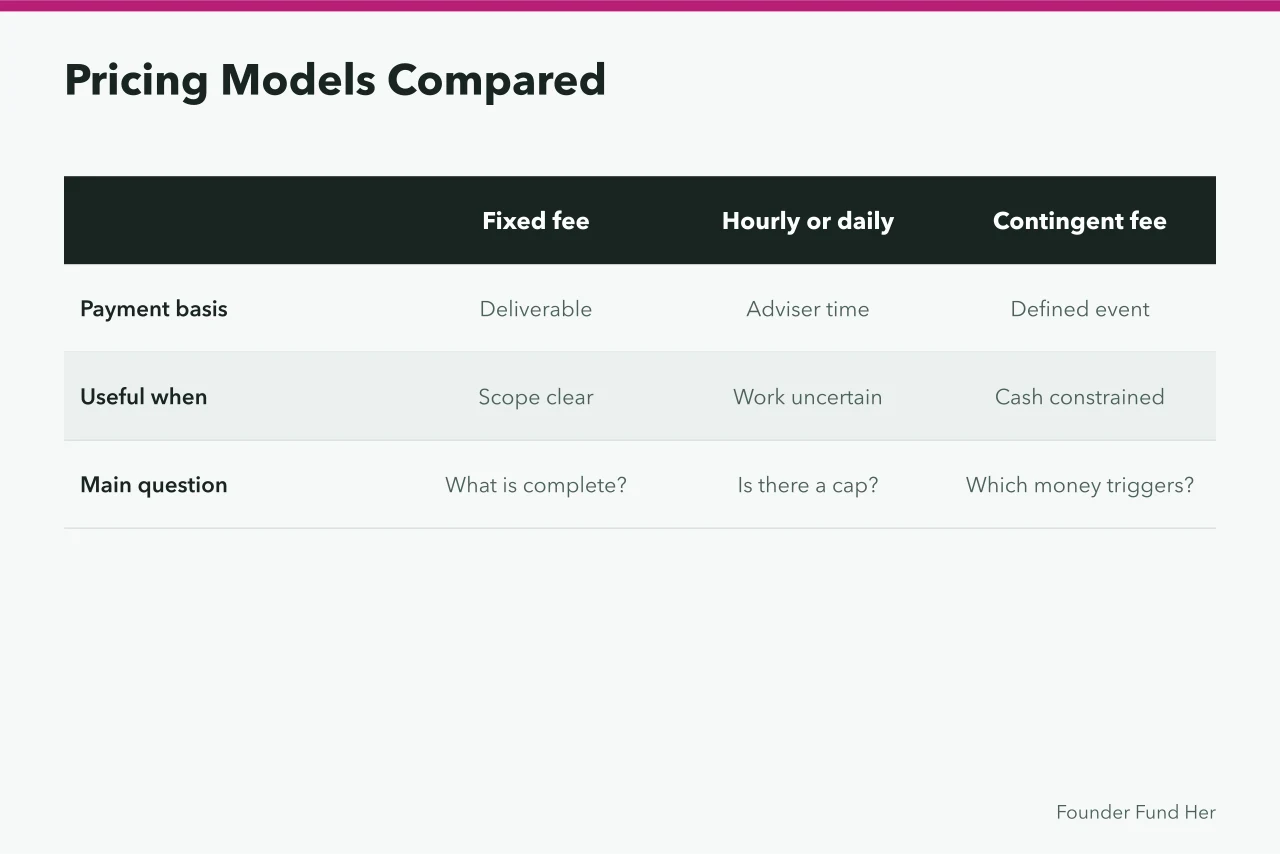
Payment basis
- Fixed fee
- Agreed deliverable or stage
- Hourly or daily
- Recorded adviser time
- Contingent fee
- Defined event, often funds raised
- Subscription
- Recurring access or service
- Debt
- Principal plus interest and charges
- Equity
- Shares or a right to future shares
Useful when
- Fixed fee
- Scope can be described and accepted
- Hourly or daily
- Work is uncertain or exploratory
- Contingent fee
- Cash before success is constrained
- Subscription
- Use is continuous and measurable
- Debt
- Repayment is affordable
- Equity
- Investor and founder accept shared ownership
Main question
- Fixed fee
- What counts as complete?
- Hourly or daily
- Is there a cap and approval gate?
- Contingent fee
- Which money triggers the fee?
- Subscription
- How do renewal and exit work?
- Debt
- Who owes and what happens on default?
- Equity
- What is the fully diluted result?
A mixed model can combine setup, monthly access and success charges. Add every layer before comparison. VAT should be shown separately and checked for the actual supply and business position.
Typical England examples include grant application support at £1,000 to £5,000 fixed, adviser time at £75 to £150 per hour, and contingent success fees of 5% to 10% of funds raised. Treat these as typical ranges, not quotes.
Interrogate service fees
For fixed work, attach deliverables, revision limits, dependencies, timetable and acceptance tests. For time pricing, agree role rates, estimates, expense rules and a written stop point. Contingent contracts need the percentage or amount, calculation base, payment date, tail period and treatment of money introduced elsewhere.
Interrogate Service Fees
- Fixed workdeliverables, revision limits, dependencies, timetable, acceptance tests
- Time pricingrole rates, estimates, expense rules, written stop point
- Contingentpercentage or amount, calculation base, payment date, tail period
- Ask what tailored work is included and which profiles qualify
- Record commissions, referral payments and restricted provider panels
Never assume that a women-focused label changes the economics. Ask what tailored work is included, which founder profiles qualify and whether a funder or sponsor subsidises the service. Record commissions, referral payments and restricted provider panels.
Compare finance on its own terms
GOV.UK described a Start Up Loan on 4 September 2026 as a £500 to £25,000 unsecured personal loan at 7.5% fixed annual interest, over one to five years, with no application or early-repayment fee. Those published terms make a useful official example, but they do not predict approval or make the product suitable for a particular founder.
The Start Up Loan is a personal loan, so the borrower remains liable even if the business does not repay. In England, delivery partners include Virgin StartUp and Newable. Women founders can also approach local Growth Hubs, Hatch Enterprise in London, and the Innovate UK Women in Innovation programme for support.
Start Up Loan Key Terms
- £500–£25,000unsecured personal loan
- 7.5%fixed annual interest
- 1–5 yearsrepayment term
- Noneapplication or early-repayment fee
Equity requires a cap-table scenario rather than an interest calculation. Show pre-money value, new money, new shares, options, conversion rights and ownership after completion. Add legal and diligence costs from live quotations. HMRC's advance-assurance guidance says assurance for EIS or SEIS addresses specified company conditions, not investor eligibility, endorsement or investment performance.
Make the decision
Build a comparison sheet with net cash received, payment timing, founder hours, total contracted charges, personal liability, ownership, control rights, continuing duties and exit. Run the calculation again if funding arrives late or only partly.
For an illustrative comparison, quote A might give £5,000 net cash, paid in 14 days, with total charges of £1,000. Quote B might give £4,500 net cash, paid in 30 days, with total charges of £1,500. The sheet puts net cash, timing and total charges side by side.
Decision Comparison Sheet
Can you state the fee trigger, regulated role, conflicts and cancellation route plainly?
Accept the proposal
Reject the proposal
Convert charges to consistent units but preserve their meaning. Show cash paid over the complete term, rather than comparing a monthly subscription with a one-off project. Keep contingent fees as both pounds and a percentage under lower, expected and higher funding outcomes. Keep equity as ownership and rights rather than forcing it into an unreliable cash equivalent.
Ask how a failed process is priced. Fixed and time-based work can be payable without an award; a contingent arrangement may still include expenses or a tail clause; a subscription can renew while a decision is pending. Model cancellation on the date the business would realistically know it should stop.
Women founders should also test whether access support, care-related scheduling or remote participation is included where personally relevant. Use the founder's actual needs and written service scope. A demographic label alone supplies no evidence about cost or availability.
Reject any proposal whose fee trigger, regulated role, conflicts or cancellation route cannot be stated plainly. The most transparent quote is often easier to govern than the lowest advertised percentage.
Publication requires current provider terms and qualified review where the comparison could be understood as financial advice.
Before you act
- Attach deliverables, revision limits, dependencies, timetable and acceptance tests for fixed work.
- Agree role rates, estimates, expense rules and a written stop point for time pricing.
- Record commissions, referral payments and restricted provider panels.
- Show pre-money value, new money, new shares, options and conversion rights for equity.
- Build a comparison sheet with net cash, payment timing, founder hours and total charges.
- Model cancellation on the date the business would realistically know it should stop.
Common questions
What should a contingent fee contract specify?
Contingent contracts need the percentage or amount, calculation base, payment date, tail period and treatment of money introduced elsewhere. The fee trigger must be stated plainly, and you should model lower, expected and higher funding outcomes.
How should equity funding be compared with debt?
Equity requires a cap-table scenario rather than an interest calculation. Show pre-money value, new money, new shares, options, conversion rights and ownership after completion. Add legal and diligence costs from live quotations, and keep equity as ownership and rights.
Does a women-focused funding support service cost more?
Ask what tailored work is included, which founder profiles qualify and whether a funder or sponsor subsidises the service. A demographic label alone supplies no evidence about cost or availability.