

Reviews
Part of How women founder funding options score for one £75,000 scenario
How to review a women founder funding agency: scope, expertise and outcome claims
A practical framework for reviewing a women founder funding agency in England, covering legal identity, regulation, expertise, costs and outcome claims.
This page gives a review framework for a women founder funding agency in England: scope, expertise, permissions, evidence, fees, accessibility, contracts and outcome claims. No ratings of named agencies here are invented. A publishable verdict needs first-hand disclosed testing, a named reviewer, current provider records, independent evidence and conflicts disclosure.
What to take away
- A registered company confirms filed identity and status, not service quality.
- Named comparators anchor a reviewInnovate UK Women in Innovation awards £50,000 per winner, NatWest's Back Her Business ran with Crowdfunder, and Start Up Loans lends £500 to £25,000 at 6% fixed interest.
- Grant-writing help typically runs from a few hundred pounds for a short form to £5,000 or more for a full Innovate UK bid, with success fees commonly 5% to 15% of any award.
- Angel and seed placement fees commonly sit at 2% to 5% of money raised, often with a 12 to 24 month tail.
- Legal work on a shareholder agreement and SEIS or EIS advance assurance typically costs £1,500 to £5,000.
- No rating should appear until the evidence gates are complete.
Verify what the agency is
Find the legal entity on Companies House and match its trading names, people, website and contract. Online incorporation costs £50 as of 2026 and a confirmation statement £34; accounts and officer records are free to view.
Verify the agency
- Find legal entity on Companies House
- Match trading names, people, website
- Define offered role
- Ask which work is regulated
- Check status on FCA Register
Define the offered role: grant writer, finance broker, investor introducer, fundraising adviser, programme designer or outsourced application team. Ask which work is regulated, legally reserved or referred to qualified professionals. Advising on investments and arranging deals in investments are regulated activities; drafting a grant bid is not.
Check relevant status on the FCA Register without assuming that a firm entry covers every activity. A financial promotion usually needs approval by an authorised person under section 21 of the Financial Services and Markets Act 2000, so ask who signs off any promotion the agency will run.
Review the women-founder proposition
Ask what changes beyond the label. Evidence might cover eligibility knowledge, networks, accessible scheduling, research or a deliberate women-focused programme design. Reject stereotypes about confidence, ambition or financial ability.
Compare named examples. Angel Academe, a London angel network founded in 2011, backs tech companies with a woman on the founding team. Addidi Business Angels is a London women's angel group, and Women Angels of the North builds angel activity in the North East.
Hatch Enterprise, a London charity, runs incubator and accelerator programmes for founders from under-represented groups. The Women's Organisation in Liverpool has supported women into self-employment for decades.
The 2019 Rose Review of Female Entrepreneurship, led by Alison Rose, estimated £250bn could be added to the UK economy if women started and scaled businesses at the same rate as men.
Check mixed-team treatment and whether demographic information influences service, monitoring or marketing. Obtain equality and privacy review where necessary.
Examine method and people
Request assigned staff, qualifications, relevant cases, source process, fact checking, version control and escalation. A persuasive salesperson is not evidence that the delivery team can review financials or investment terms.
Ask for the named lead and their qualification: ICAEW or ACCA membership, chartered tax adviser status, or FCA authorisation for investment work. Membership of the UK Business Angels Association or the UK Crowdfunding Association signals a published code of conduct, not a guarantee.
Dummy scenario test
- Submit permitted dummy scenario
- Record response and questions
- Check source accuracy
- Note exclusions and accessibility
- Never submit false live application
Test one permitted dummy scenario from enquiry to proposed scope. Record response, questions, source accuracy, exclusions and accessibility. Do not submit a false live application merely to create review content.
Compare contract and whole cost
Break out fixed, hourly, subscription, expense, commission and success elements. Define the success event, calculation base, tail period and money introduced elsewhere. Include founder time, legal review and post-award work.
Rates to budget against, as of 2026. Start Up Loans charges 6% fixed annual interest with no early repayment penalty, a useful benchmark when a broker quotes a percentage. SEIS gives 50% income tax relief on up to £250,000 raised in a company's lifetime; EIS gives 30% on up to £1m a year, or £2m for knowledge-intensive companies.
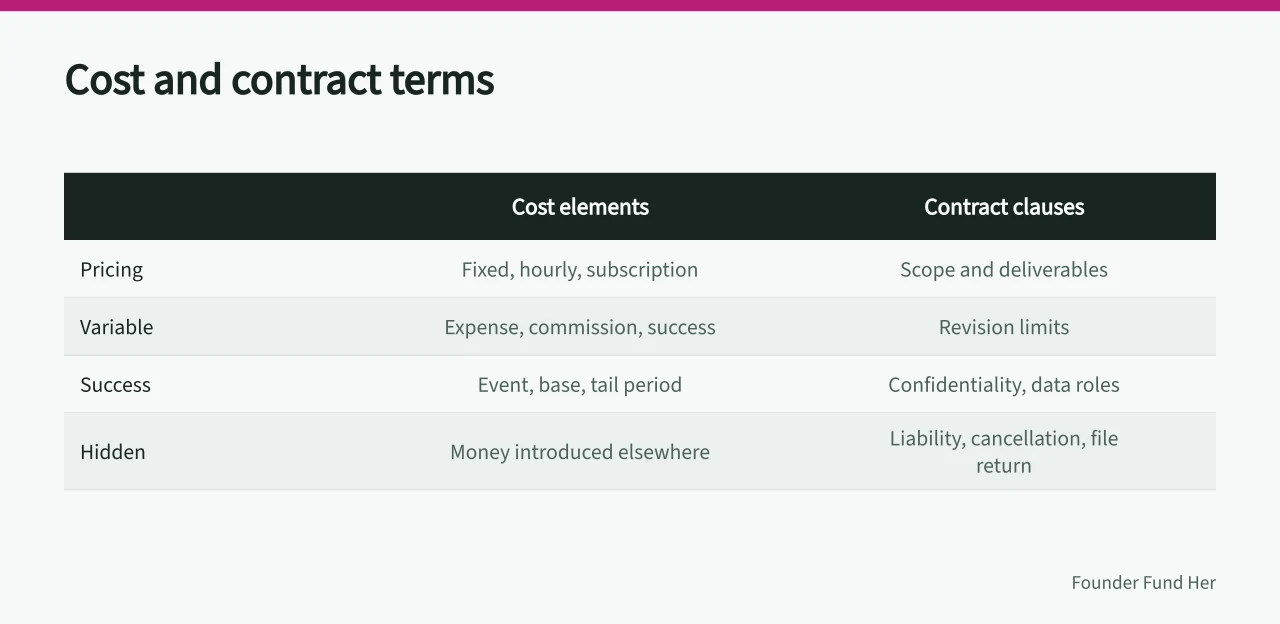
Inspect scope, deliverables, revision limits, confidentiality, data roles, publicity, conflicts, subcontracting, liability, cancellation and file return. The lowest percentage can conceal the longest continuing obligation.
Validate outcome claims
For funding secured, ask for period, route, denominator, gross or net basis and independent evidence. A testimonial is a selected experience, not an approval rate. Include failed and difficult work when sampling references.
The Investing in Women Code signatory list can verify a stated commitment for listed organisations, but does not certify an agency or guarantee funding.
The Code launched in 2019 with HM Treasury backing and is administered by the British Business Bank. Signatories commit to collecting gender data on applications and to naming a senior executive responsible for the work.
The British Business Bank also publishes the share of Start Up Loans taken by women-led businesses each year. That figure is a public benchmark for any lending or funding claim a firm makes.
Publish a limited verdict
State date, reviewer, method, relationships, tested scenario, known facts, unknowns and best-fit audience. Give the agency a factual correction route. No rating should appear until those evidence gates are complete.
Publish the Companies House number and any FCA reference so a reader can repeat the checks. Say plainly which parts of the service were not tested.
Test a bounded working sample
Give comparable agencies the same written dummy brief, response window and questions. Ask for scope, assigned team, deliverables, exclusions and timetable. Then ask for fee triggers, evidence needed, regulation, data use and exit. Do not reveal competitor responses during the exercise.
Score independently before discussing results. Preserve proposals and note where a sales response differs from the draft contract. Unknown answers should remain unknown rather than receiving an average score.
Ask the agency to identify one route that does not fit and explain why. A credible adviser can decline unsuitable work instead of turning every enquiry into a paid project.
Worked example, anonymised. Two agencies quote for the same £50,000 Innovate UK Women in Innovation award. Agency A charges a 15% success fee, £7,500, with a 12 month tail.
Agency B charges 5%, £2,500, with a 24 month tail. Both sit inside the typical 5% to 15% success fee range. The score then turns on the named lead and the tail period, because the longer tail can outweigh the lower headline fee.
After provisional scoring, conduct factual checks with each agency and keep judgement independent. Publish the sample, method and limitations. An agency that was not tested should not receive an implied failing score.
Before you act
- Find the legal entity on Companies House.
- Define the offered role and check regulation.
- Test one permitted dummy scenario from enquiry to scope.
- Break out all cost elements and define success.
- Validate outcome claims with period and denominator.
- Publish a limited verdict with date and method.
Common questions
How can I verify a women founder funding agency's legal identity?
Start at Companies House and match the filed entity to its trading names, people, website and contract. Filing costs are small, so a matching record is the minimum check. Then confirm any regulated activity on the FCA Register, since a firm entry may not cover every service line.
What should I ask for when reviewing outcome claims?
Ask for the period, the funding route, the denominator and whether the figure is gross or net. Seek independent evidence and ask for failed or difficult references alongside the successes. The Investing in Women Code signatory list shows a stated commitment for listed organisations; it does not certify an agency.
How do I test an agency's method without submitting a false application?
Use one permitted dummy brief from enquiry to proposed scope. Record response time, questions, source checks, exclusions and accessibility. Never submit a false live application. You can include a fictional scheme name in the brief to see whether the agency checks before repeating it.