

Strategy
Part of A women founder funding strategy that funds a milestone, not a vague ambition
A women founder funding strategy framework
Use a women founder funding strategy framework to map named UK routes, check eligibility, compare net cash and set a fallback for each milestone.
A funding strategy should buy a business milestone without creating an obligation the founder or company cannot carry. Gender may affect access, networks and lived experience, but the plan still begins with cash, evidence, route fit and terms.
What to take away
- Map funding routes by amount, purpose, legal form, trading history, geography, sector, timing and acceptable consideration.
- Link every material claim to a record and reconcile numbers across forecast, deck and application.
- Compare net outcomes by calculating gross funding, deductions, spend before receipt, expected net cash and timing.
- Approve a fallback that narrows scope, stages hiring, seeks deposits, approaches another route or pauses the milestone.
Frame the milestone
Name the result the money must produce: tested demand, regulatory clearance, first production, repeatable sales or entry into a new market. Set the minimum cash, target amount, latest safe receipt and evidence that the milestone has been reached.
Milestone funding numbers
- Minimum cashcash floor
- Target amountfunding goal
- Latest safe receiptdeadline
- Evidencemilestone reached
Build a monthly downside forecast. Protect a cash floor that reflects company and founder realities. If the plan includes personal borrowing, show the household obligation separately. Do not assume unpaid caring or founder labour can absorb every delay.
Map the route
The GOV.UK business finance support service explains their broad structures and trade-offs. Treat it as orientation, then verify each live product.
Funding route trade-offs
Grant
- Ownership
- preserved
- Payments
- none
- Activity
- restricted
- Claims
- required
- Rights
- none
Debt
- Ownership
- preserved
- Payments
- regular
- Activity
- free
- Claims
- none
- Rights
- lender
Equity
- Ownership
- transferred
- Payments
- dividends
- Activity
- free
- Claims
- none
- Rights
- shareholder
Screen routes by amount, purpose, legal form, trading history, geography, sector, timing and acceptable consideration. A grant may preserve ownership but restrict activity and require claims. Debt creates payments. Equity transfers shares and rights.
Named UK routes include British Business Bank programmes, such as Start Up Loans delivered through partners, and Innovate UK grants and innovation loans for research and development. Investing in Women Code signatories include banks, venture capital firms and other finance providers that report gender-disaggregated data. Check each provider's current criteria, because delivery partners and funds change.
Innovate UK’s Women in Innovation Awards are a named competition aimed at women in leadership at innovative businesses. Each round’s competition brief sets the qualifying role and organisation criteria, award terms and opening dates; applications go through Innovate UK’s competition service.
Women-focused equity routes include Angel Academe, an angel network investing in women-led businesses, and Alma Angels, a network backing female founders. Check each network’s current investment criteria and pitch process; neither guarantees investment.
Typical UK amounts vary by route. Start Up Loans run from £500 to £25,000 per founder, capped at £100,000 per business, with repayment over one to five years. Innovate UK grants depend on the competition and usually require match funding.
Equity cheques at pre-seed and seed stage commonly range from about £50,000 to £2 million, in exchange for shares and rights. Treat these as broad ranges and check current terms.
For a UK equity raise, assess whether the Seed Enterprise Investment Scheme (SEIS) or Enterprise Investment Scheme (EIS) may apply. These are investor tax-relief schemes, not grants or guaranteed sources of capital; check company and investor eligibility and consider HMRC advance assurance before relying on either in a fundraising plan.
For qualifying research and development, review HMRC’s R&D tax relief rules, including the merged R&D expenditure credit (RDEC) and Enhanced R&D Intensive Support (ERIS), where applicable. Treat a claim as potential tax relief subject to eligibility and claim requirements, not cash committed by a funder.
Map access conditions
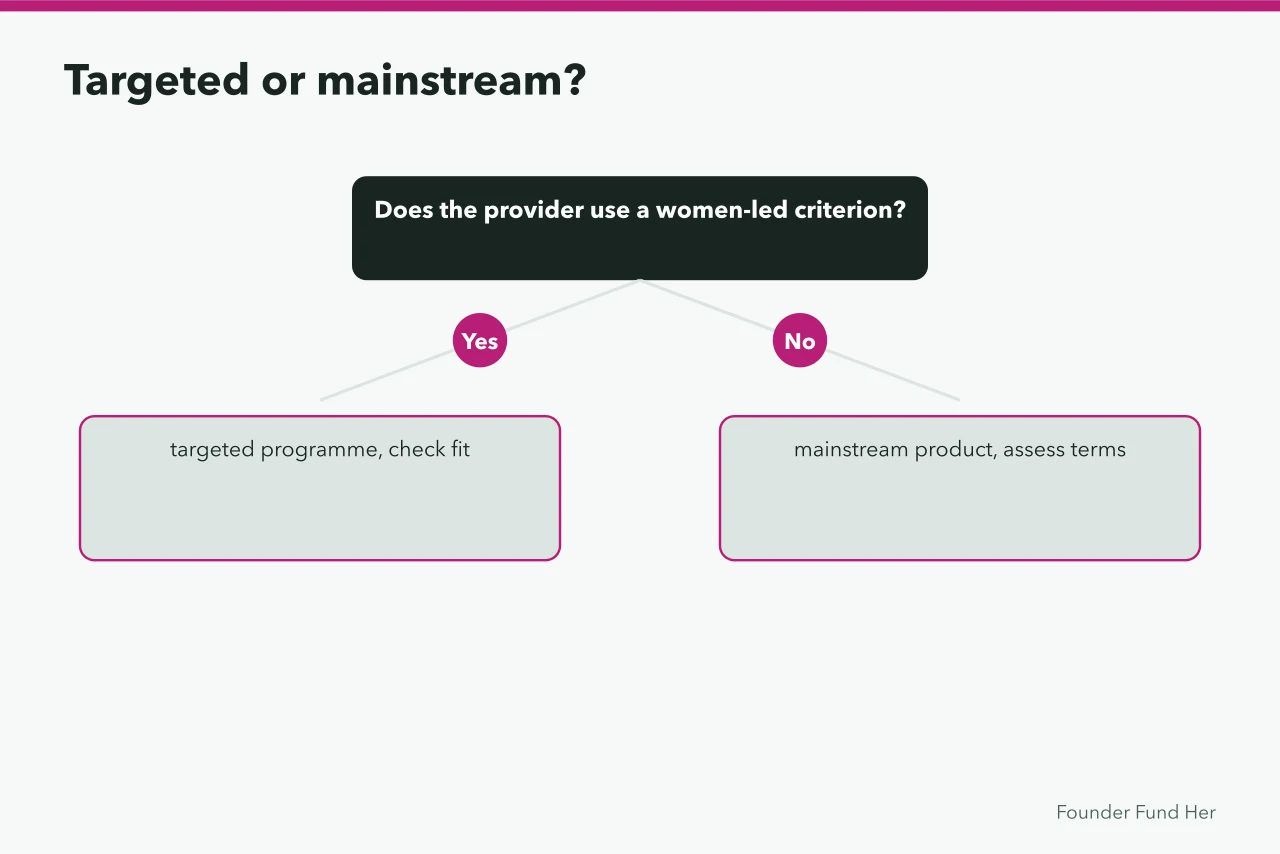
Record whether the provider uses a women-led, women-owned or founder criterion and how it treats mixed teams. Do not make targeted funding the entire strategy. Mainstream products may fit better, while targeted programmes may supply useful support or networks.
The Investing in Women Code annual report describes gender-disaggregated provider reporting and inclusion commitments. Named signatories include NatWest and Barclays; check the current signatory list and each provider’s current products. Code participation can inform due diligence but cannot replace a product assessment.
Build the evidence spine
Link every material claim to a record: accounts, bank cash, customer research, contracts, technical tests, market data, ownership records and delivery plan. Reconcile numbers across the forecast, deck and application. Assign a technical and financial owner.
Keep demographic narrative factual. Do not exaggerate discrimination, confidence or caring responsibilities to fit a funder's assumed story. Explain actual barriers only when they affect the business or proposed support.
Compare net outcomes
For each route, calculate gross funding, deductions, spend before receipt, expected net cash and timing. Then record repayment, personal exposure, dilution, control rights, delivery conditions and reporting.
An illustrative example: a £50,000 grant with £5,000 of claim and legal costs, plus £8,000 spent before receipt, leaves £37,000 net cash when paid at month four. A £50,000 loan with a £2,500 fee, £6,000 spent before receipt and £7,500 first-year interest leaves £34,000 net cash, but adds repayments.
Use three outcomes: proceed, resolve evidence, or reject. Add a stop date and the cost of another month. Probability should reflect observed progress, not enthusiasm after a meeting.
Approve a fallback
Decide what happens if the amount is smaller, the decision is late or the application fails. Options include narrowing scope, staging hiring, seeking customer deposits, approaching another route or pausing the milestone. Identify actions requiring employment, legal or tax advice.
Review the strategy at cash, evidence and decision triggers. A changing market does not require weekly reinvention; a breached runway assumption does.
Put the framework through a red-team review
Give a colleague the funding specification, forecast and source pack, but not the preferred route. Ask her to identify the first eligibility failure, the weakest financial assumption and the obligation most likely to be misunderstood. Compare her answer with the team's rationale.
Test the communication burden as well. An equity process may require repeated meetings; a grant may demand partner coordination; a loan may need fast document responses. Assign cover so a caring emergency, illness or customer deadline does not stop the whole application.
Before you act
- Name the result the money must produce.
- Set minimum cash, target amount and latest safe receipt.
- Build a monthly downside forecast and protect a cash floor.
- Record whether the provider uses a women-led criterion.
- Link every material claim to a record.
- Give a colleague the funding specification for red-team review.
Common questions
What should a funding strategy achieve without creating an obligation?
It should fund a named result. The plan begins with cash, evidence, route fit and terms, even though gender may affect access, networks and lived experience.
How should a founder screen different funding routes?
Screen routes by amount, purpose, legal form, trading history, geography, sector, timing and acceptable consideration. A grant may preserve ownership but restrict activity and require claims. Debt creates payments. Equity transfers shares and rights.
What should a founder do if the funding amount is smaller or the decision is late?
Decide what happens if the amount is smaller, the decision is late or the application fails. Options include narrowing scope, staging hiring, seeking customer deposits, approaching another route or pausing the milestone. Identify actions requiring employment, legal or tax advice.