
Audience research
Part of Women founder funding audience research: inclusive recruitment and decision-led analysis
Women founder funding interviews: a twelve-question script and session care
Run women founder funding customer interviews with a twelve-question script, a practice session, a distress protocol and careful handling of notes.
A funding interview works when the researcher asks about one real funding episode and stays with the participant's language. The twelve questions below follow that episode from need to aftermath. What makes the session safe is the preparation around them: a practice run, a distress protocol and clear limits on what is collected.
What to take away
- Ask about decisions, documents, dates and alternatives, and let participants skip sensitive details.
- Practise the script with a colleague who plays a participant under cash pressure.
- Keep participation consent separate from the lawful basis, and stop and delete data if consent is withdrawn.
- Set a distress and disclosure protocol before the first session.
- Separate incentive administration from research responses after the interview.
Twelve questions
Interview founders about a real funding episode. General questions about confidence or ambition invite vague answers and can reinforce the researcher's assumptions. Ask for decisions, documents, dates and alternatives, and allow participants to skip sensitive details.
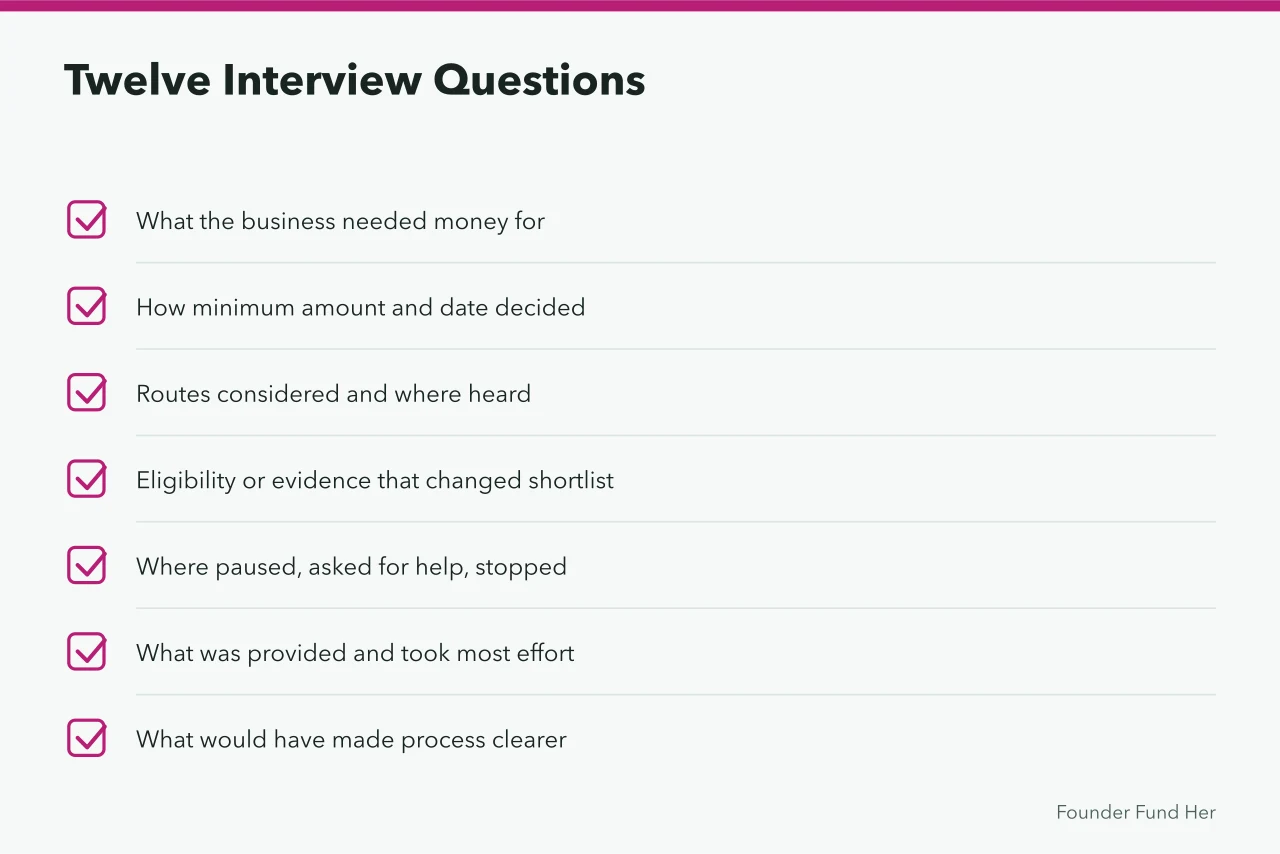
- What did the business need money for, and when did that need become clear?
- How did you decide the minimum amount and the latest useful receipt date?
- Which routes did you consider, and where did you first hear about each one?
- What made an option look suitable before you checked its full conditions?
- Which eligibility or evidence requirement changed your shortlist?
- Did you start an application, request terms or speak to an investor? What happened next?
- Where did you pause, ask for help or decide to stop?
- What were you asked to provide, and which item took most effort?
- If you received an offer, how did it compare with the amount and timing required?
- Which repayment, security, ownership or delivery condition mattered most?
- What did you do after the decision, including self-funding or changing the plan?
- What would have made the process clearer without pushing you towards finance?
Follow the participant's language. Ask for an example when an answer becomes general, but do not challenge a rejection account as though the interview were an appeal.
Practising before the first session
Run a practice session with a colleague who plays a participant under cash pressure. Check whether the introduction creates an expectation of funding or individual advice.
Replace questions that seek justification, contain two issues or name a presumed barrier. Prepare neutral follow-ups such as "What happened next?" and "Which record showed that?"
| Problem | Example of the fault | Neutral version |
|---|---|---|
| Seeks justification | "Why did you not choose a grant?" | Which routes did you consider, and where did you first hear about each one? |
| Contains two issues | "How long did the form take, and was it confusing?" | Where did you pause, ask for help or decide to stop? |
| Names a presumed barrier | "Did being a woman make investors harder to reach?" | What made an option look suitable before you checked its full conditions? |
Starting the session with consent and limits
Explain the purpose, recording, incentive, storage, access, quotation process and withdrawal route before the session. Participation consent and the data-protection lawful basis are related but distinct decisions, so record both.
GOV.UK's user research guidance says researchers must get a participant's informed consent, which means a record showing that they understand the research and agree to take part.
Protect the Participant
- Explain purpose, recording, incentive, storage
- Explain access, quotation process, withdrawal route
- Separate consent from data-protection lawful basis
- Do not request bank statements or credit scores
- Do not request investor names or protected characteristics
- Remove identifying details from notes
- Suppress quotations that could expose a founder
The lawful basis comes from UK GDPR and the Data Protection Act 2018, and the Information Commissioner's Office (ICO) is the regulator that enforces them. Record which basis you rely on for the interviews, separately from the consent a participant gives to take part, so a withdrawal is handled the right way.
Do not request bank statements, credit scores, investor names or protected characteristics unless the research question genuinely requires them. Remove identifying details from notes and use suppression when a quotation could expose a founder in a small sector.
If a participant becomes distressed
Set a distress and disclosure protocol before the first session. The researcher should know how to pause, stop recording, remove an answer and signpost an appropriate service without diagnosing or promising help. Samaritans (emotional distress) and StepChange (debt advice) are two services to name.
Never ask a participant to display a bank account, lender portal or confidential investor message during screen sharing. A funding story can involve rejection, debt or family money, so the participant decides what to show and what to leave out.
Withdrawal is part of the same protocol. If a participant withdraws consent during a research session, the GOV.UK guidance says to stop and delete any research data collected.
Who the script suits
The script works best across contrasting journeys, so include successful and rejected applicants, partial offers, abandoned forms, founders who never applied and people already delivering funded work. Vary route, company age, sector and English region.
The GOV.UK guide to finding participants says to make sure recruits are representative of the actual and likely users of a service. Sampling design itself belongs to the audience research guide.
Recruit Contrasting Journeys
Include
- Applicant outcome
- Successful, rejected, partial
- Application stage
- Abandoned forms, never applied
- Route and region
- Vary route, sector, English region
- Recruitment channel
- Diverse channels, disabled, limited digital
Avoid
- Applicant outcome
- Only successful
- Application stage
- Only completed applications
- Route and region
- Single route or region
- Recruitment channel
- Women-founder event or paid list
Avoid recruiting only from a women-founder event or paid customer list. Those channels can miss less connected founders and people dissatisfied with the service.
After the session
Write observations during a same-day review, then group evidence around discovery, eligibility, effort, terms, decision and aftermath. Separate what happened from the researcher's interpretation. Look for disconfirming cases.
Analyse as a Team
- Write observations during same-day review
- Group evidence around discovery, eligibility, effort
- Group evidence around terms, decision, aftermath
- Separate what happened from interpretation
- Look for disconfirming cases
- End round with changed decision and recruitment gap
End each round with a changed decision and a recruitment gap. A memorable story is not a market rate, and twelve interviews cannot establish an England-wide percentage.
Separate incentive administration from research responses and confirm the retention date. Log any accidental collection so the data owner can act, as set out in women founder funding data protection. Publication requires participant documentation, source records and a named research reviewer.
Before you act
- Ask for decisions, documents, dates and alternatives.
- Run a practice session with a colleague under cash pressure.
- Explain recording, storage, access and withdrawal before the session.
- Do not request bank statements, credit scores or investor names.
- Agree the distress and disclosure protocol.
- Separate incentive administration from research responses afterwards.
Common questions
What should a researcher do if a participant withdraws consent mid-session?
Stop, and delete any research data collected, as GOV.UK's guidance on informed consent requires. Withdrawal is part of the distress and disclosure protocol agreed before the first session.
Is consent the same as the lawful basis?
No. Participation consent and the data-protection lawful basis are related but distinct decisions, and both should be recorded.
Can twelve interviews give an England-wide percentage?
No. A memorable story is not a market rate, and twelve interviews cannot establish an England-wide percentage.