
Audience research
Part of Women founder funding audience research: inclusive recruitment and decision-led analysis
A reproducible checklist for researching women founder funding competitors
Research women founder funding competitors in England using a reproducible checklist for identity, audience, claims, price, coverage and evidence.
Research the job a service performs, the customer it accepts and the way it earns. A bank, grant programme, investment fund, accelerator, directory and adviser may all appear for the same search while operating under different rules.
What to take away
- Group competitors by route and model before comparing, since a bank, fund and adviser operate under different rules.
- This is a research process, not a ranked list of funding options.
- Code participation shows provider practice, not proof that a product fits a founder.
- Date every observation and cite the public source.
- Competitor research may inform strategy but must not copy protected content or submit false enquiries.
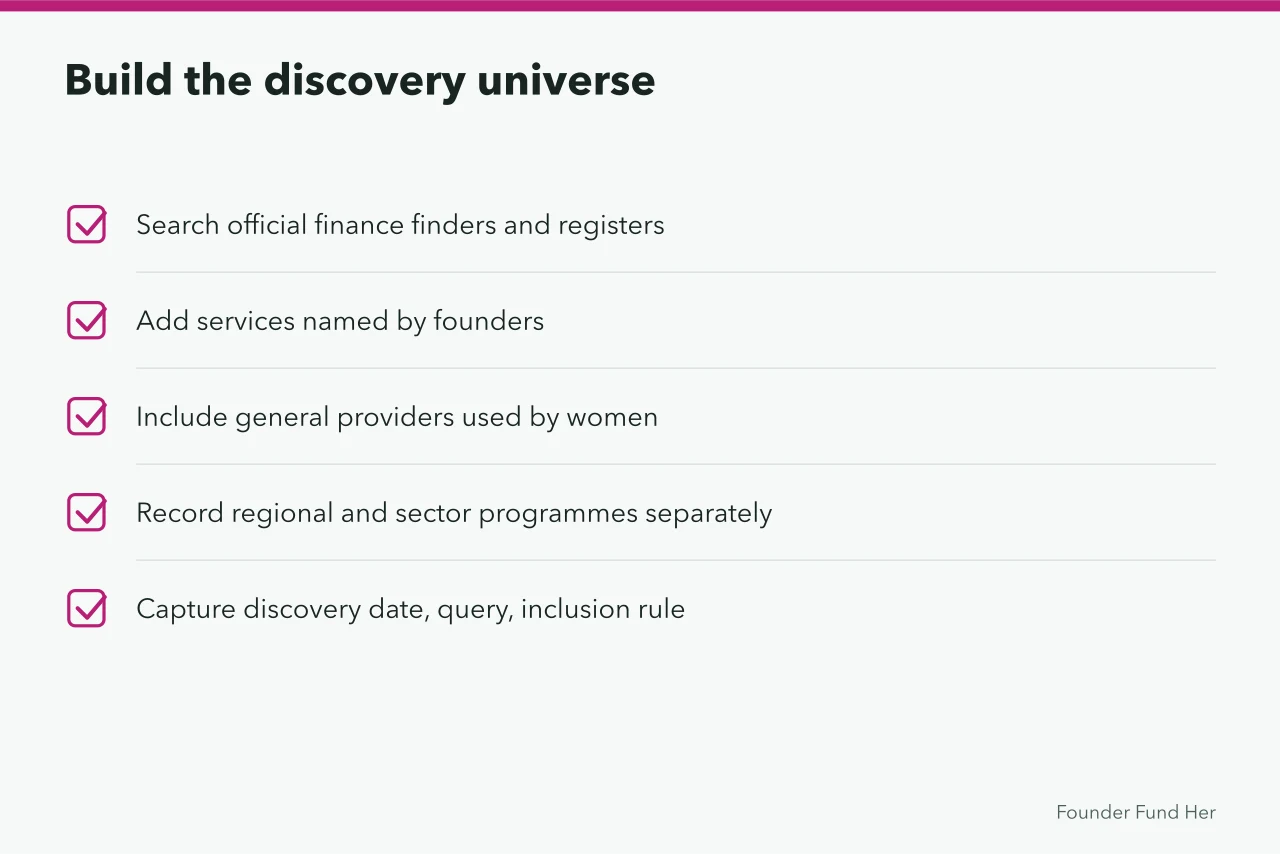
Build the discovery universe
- Search official finance finders, public scheme pages and provider registers.
- Name concrete routes such as Start Up Loans, Innovate UK Women in Innovation, and NatWest Women in Business.
- Add services named by founders in interviews, including those they rejected.
- Include general providers used by women, not just women-branded organisations.
- Record English regional and sector programmes separately.
- Capture the discovery date, query and inclusion rule.
The Investing in Women Code 2026 page describes a large signatory population across finance. Code participation is a relevant provider-practice field, not proof that one product fits a founder.
Verify identity and role
- Map brand, legal entity, company number and registered address.
- Identify lender, broker, adviser, investor, fund manager, platform and delivery partner roles.
- Use Companies House for corporate records.
- Search the FCA Register when the activity may be regulated.
- Save evidence of trading names and permissions.
Do not score incorporation or authorisation as customer satisfaction. These checks establish who is acting and under which recorded status.
Verify identity and role
- Map brand, legal entity, company number
- Identify lender, broker, adviser, investor roles
- Use Companies House for corporate records
- Search FCA Register for regulated activity
- Save evidence of trading names and permissions
Record the offer fields
- Audience definition and treatment of mixed founding teams.
- Geography, sector, stage, legal form and trading requirements.
- Amount, service, allowed use and application window.
- Interest, fees, commission, equity or sponsor payment.
- Evidence, timetable, decision process and post-funding obligations.
- Complaints, cancellation, privacy and accessibility routes.
Use "unknown" rather than interpreting a missing price or eligibility rule. Contact the provider with the same written questions and retain the response date.
| Field | Start Up Loans (British Business Bank) |
|---|---|
| Identity | Public scheme delivered by British Business Bank; check Companies House for the delivery partner |
| Offer | Personal loan up to £25,000 for eligible founders; confirm use and eligibility on the scheme page |
| Claims | Check any published success rate for denominator, period and definition |
| Price | Interest rate published by British Business Bank; record unknown if not shown |
| Date | 9 May 2026 |
Capture the offer consistently
- Audience definition and mixed founding teams
- Geography, sector, stage, legal form
- Amount, service, allowed use, window
- Interest, fees, commission, equity, sponsor payment
- Evidence, timetable, decision process, obligations
- Complaints, cancellation, privacy, accessibility routes
Audit claims
- Trace market-size and outcome claims to the original source.
- Ask for denominator, period, definition and independent verification behind success rates.
- Separate money raised by customers from money supplied by the service.
- Record disclaimers and material limitations beside the headline.
For example, Innovate UK's Women in Innovation 2025 to 2026 page is an authoritative record marked closed. A competitor that lists it as open fails a basic freshness check.
Compare routes and spot gaps
Look for gaps in verified opportunity data, regional access, application support, affordable readiness work, accessible research and post-funding operations. Confirm the gap with founders rather than assuming an absent feature represents demand.
Named example
- Bank
- NatWest Women in Business
- Grant
- Innovate UK Women in Innovation
- Adviser
- FCA-authorised adviser
Identity check
- Bank
- Companies House for legal entity; FCA Register where regulated
- Grant
- Innovate UK scheme page
- Adviser
- FCA Register
Offer field
- Bank
- Business account, loan or support route
- Grant
- Award funding and support; status marked closed
- Adviser
- Application or readiness support
Price field
- Bank
- Rate or fee often unknown until quote
- Grant
- Not applicable; grant
- Adviser
- Fee model, hourly or fixed
Date checked
- Bank
- 9 May 2026
- Grant
- 9 May 2026
- Adviser
- 9 May 2026
Keep the record current
Assign high update risk to prices, deadlines, provider status and permissions. Recheck these fields on publication day. Give firms a chance to correct factual descriptions and disclose paid relationships. Check every factual description against the public source before you publish.
Test the comparison from a founder's position
Create three evidence-based funding jobs and run every apparently eligible service through them. Record where information is discoverable, which question remains unanswered and when the provider requires personal data. Do not submit the form or seek a personalised offer unless the research uses a real consenting business and the provider is told the truth.
Check whether a women-focused description changes the actual route, support or eligibility. A general provider with a clear process may solve the job better; a specialist community may add network value even when it supplies no capital. Preserve both distinctions.
Archive screenshots or page records only as allowed, cite the public source and date the observation. Search presentation is volatile and should never be the sole evidence for price or status.
Before you act
- Record the discovery date, query and inclusion rule.
- Map brand, legal entity, company number and registered address.
- Trace market-size and outcome claims to the original source.
- Recheck prices, deadlines, provider status and permissions on publication day.
- Run three evidence-based funding jobs through every eligible service.
Common questions
How should a researcher handle a missing price or eligibility rule?
The checklist keeps that field open until the provider confirms it. Contact the provider with the same written questions and retain the response date. This keeps the record honest and avoids inventing facts that later mislead a founder comparing services.
What does Investing in Women Code participation actually prove?
The article states that code participation is a relevant provider-practice field, not proof that one product fits a founder. The 2026 page describes a large signatory population across finance. It should be recorded alongside other fields, not scored as customer satisfaction or suitability.
Why does a closed scheme still appearing as open matter?
The article says Innovate UK's Women in Innovation 2025 to 2026 page is an authoritative record marked closed. A competitor that lists it as open fails a basic freshness check. Check the source page before you cite a scheme as open.