
Audience research
Part of Women founder funding audience research: inclusive recruitment and decision-led analysis
Defining a women founder funding audience by funding job rather than stereotype
Define and research a women founder funding audience in England by funding job, route, stage and access need without relying on stereotypes.
Define the audience by the funding decision she faces, not gender alone. A founder seeking a £15,000 loan for equipment, a mixed founding team preparing a seed round and an innovator applying for a grant may all fit the broad label while needing different evidence and services.
This draft needs research-ethics, privacy and inclusion approval before release.
What to take away
- Define the audience by the funding decision she faces, not by gender alone.
- Segment founders by funding job, from pre-trading testing to funded firms facing repayments.
- Recruit beyond accelerator alumni and successful raisers to include discouraged applicants.
- Compare stated need with behaviour such as routes viewed and applications started.
- Publish a recruitment record and name assumptions confirmed, rejected or still uncertain.
Write a behavioural definition
Start with a recent or approaching event: considering finance, choosing a route, preparing an application, responding to rejection, negotiating terms or managing money already received. Add business stage, amount, purpose and deadline.
State what "woman founder" means for the research. Invite self-description and explain treatment of co-founders. Do not infer identity from a name or photograph. If a product has formal eligibility, keep its rule separate from the wider research population.
Segment by funding job
Useful first segments include:
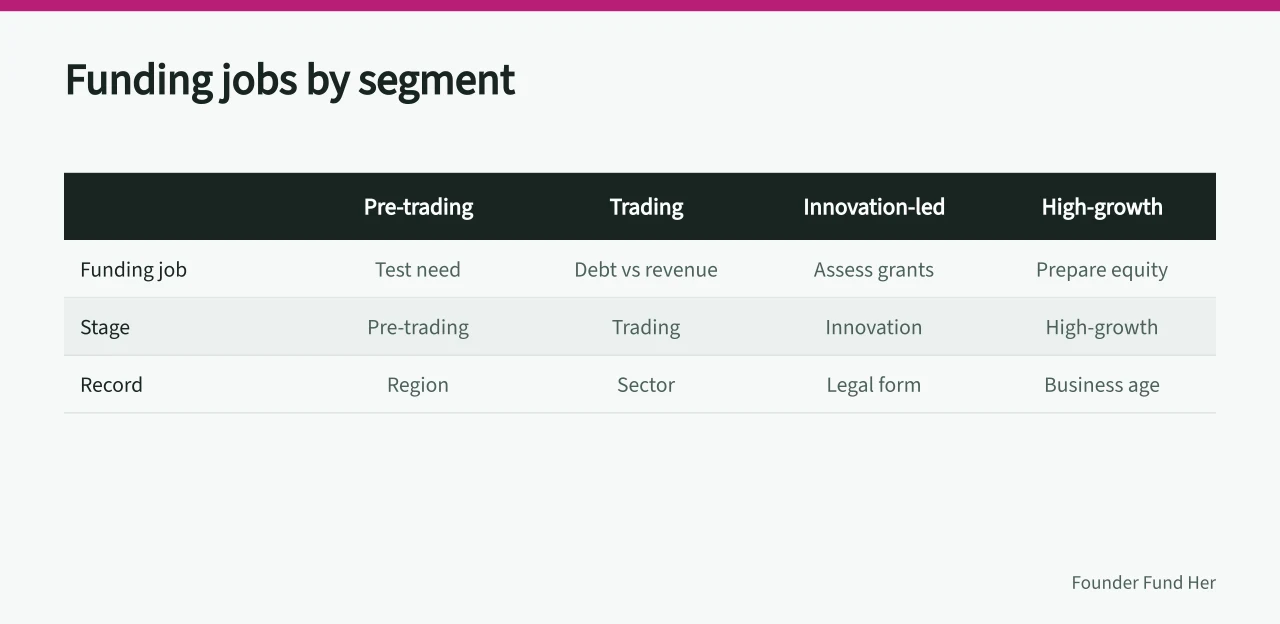
- pre-trading founders testing whether outside money is needed;
- trading firms choosing between debt and retained revenue;
- innovation-led teams assessing grants;
- high-growth companies preparing angel or venture equity;
- previously discouraged or rejected applicants; and
- funded founders facing claims, repayments or investor reporting.
For example, a pre-trading founder might test a Start Up Loan of £15,000. A trading firm might compare a bank overdraft with retained revenue. An innovation team could apply for an Innovate UK Smart Grant.
A high-growth company might prepare for angel investment through the Angel CoFund. A previously rejected applicant could revisit the Start Up Loans programme after a bank decline. A funded founder might manage Bounce Back Loan repayments. As a guide, recruit 6 to 8 participants per segment for a qualitative round.
Within each group, record English region, sector, legal form, business age, trading evidence and the founder's acceptable obligations. Caring responsibilities, disability, ethnicity, immigration status and digital access may shape a journey, but should be researched rather than assumed.
Recruit beyond visible networks
The GOV.UK Service Manual's participant recruitment guidance (accessed 2024) recommends using varied recruitment approaches and including people with disabilities, limited digital skills or support needs. For this market, recruit through local business groups, finance providers, community organisations, professional networks and open calls.
Recruit beyond visible networks
- Use varied recruitment approaches
- Include disabilities and support needs
- Recruit via local business groups
- Recruit via finance providers
- Recruit via community organisations
- Include abandoned form users
- Offer flexible interview times
Do not build the sample entirely from accelerator alumni or successful raisers. Include people who abandoned a form, used savings, accepted an unsuitable partial offer or never encountered the service.
Offer interview times around business and caring work. Ask about communication formats, travel and assistive technology before the session. Pay a proportionate incentive without linking it to positive comments.
Check the audience against evidence
The Small Business Access to Finance call for evidence (2023) includes an access-to-finance review that lists awareness, perceived rejection, confidence and cultural factors among barriers for under-served entrepreneurs. Treat these as research prompts, not a diagnosis of every participant.
Stated need vs behaviour
Stated need
- Awareness
- Says unaware
- Rejection
- Expects refusal
- Confidence
- Feels unsure
- Control
- Rejects equity
Observed behaviour
- Awareness
- Routes viewed
- Rejection
- Applications started
- Confidence
- Evidence requested
- Control
- Offers and decisions
Compare stated need with behaviour: routes viewed, applications started, evidence requested, time spent, offers and decisions. A founder who rejects equity to preserve control may understand finance perfectly well.
Produce a recruitment record
For every round, publish the segment definition, screener, channels, response pattern, participant mix, incentive and missing voices. Suppress details that could identify a person in a small regional or sector cohort.
For example, a screener might ask: "In the last 12 months, have you applied for a business loan, grant or equity investment?" and record the outcome (applied, declined, offered, accepted).
End with decisions. Name the service assumption confirmed, rejected or still uncertain and the next group to recruit. An audience definition is useful only when it changes content, product or support.
Check reach with a coverage matrix
Create rows for funding stage and columns for region, route and access need. Place each recruited participant in the relevant cells, allowing one person to appear in several dimensions without counting her twice in the total. The matrix shows blind spots; it does not make a small qualitative sample representative.
Illustrative example:
Coverage matrix
| Funding stage | Region | Route | Access need | Participant |
|---|---|---|---|---|
| Pre-trading | North West | Start Up Loan | Caring responsibilities | P1 |
| Trading | South East | Overdraft | Disability | P2 |
| Innovation | East of England | Innovate UK grant | Digital access | P3 |
| High-growth | London | Angel equity | None recorded | P4 |
| Discouraged | West Midlands | Start Up Loan | Ethnicity | P5 |
| Funded | Yorkshire | Bounce Back Loan | Repayment pressure | P6 |
Review who benefits from the eventual decision. If a feature improves the journey for an equity-ready London network but adds work for first-time borrowers elsewhere, make the trade-off visible and commission another round.
Before you act
- Start with a recent or approaching funding event. (Ownerresearch lead)
- Publish the woman founder definition used in the research. (Owner: research lead; output: shared document)
- Recruit through local groups, providers and open calls. (Owner: recruitment coordinator; output: channel list)
- Offer interview times around business and caring work. (Owner: fieldwork manager)
- Publish segment definition, screener, channels and participant mix. (Owner: research lead; output: recruitment record)
Common questions
Which groups should recruitment include beyond visible networks?
Recruit through local business groups, finance providers, community organisations, professional networks and open calls. Do not build the sample entirely from accelerator alumni or successful raisers. Include people who abandoned a form, used savings, accepted an unsuitable partial offer or never encountered the service.