

Audience research
Part of Women founder funding audience research: inclusive recruitment and decision-led analysis
Five ways to survey women founders about funding, and the data risks of each
Compare five tools for surveying women founder funding needs in England, including strengths, sampling limits, accessibility and serious data risks.
Choose a survey tool by research job and participant access. Software features do not repair a biased sample, ambiguous gender definition or leading questionnaire. This comparison covers method categories rather than endorsing a commercial platform.
What to take away
- Choose a survey tool based on the research job and participant access, not on software features.
- Every method has specific data risks, from self-selection to interviewer effects to panel verification.
- Common controls include writing an analysis plan first and testing data handling with a dummy dataset.
- Select the smallest tool that can meet the research question safely and honour participant requests.
Hosted online questionnaire
Best for: structured responses from a known list across several English regions.
Hosted online questionnaire
Strengths
- Routing
- Yes
- Validation
- Yes
- Rapid export
- Yes
- Accessible completion
- If built well
- Sample control
- Known list
Weaknesses
- Routing
- —
- Validation
- —
- Rapid export
- —
- Accessible completion
- Excludes poor connectivity
- Sample control
- Self-selection, forwarding
Checks
- Routing
- Test
- Validation
- Test
- Rapid export
- Test
- Accessible completion
- Assistive tech test
- Sample control
- Duplicate checks
Strengths include routing, validation, rapid export and accessible completion when the form is built and tested well. Weaknesses include self-selection, duplicate responses, exclusion of people with poor connectivity and easy forwarding outside the sample.
Typical platforms include SmartSurvey, Jisc Online Surveys, SurveyMonkey, Qualtrics and Google Forms. Costs run from free tiers to mid-tier plans published at roughly £20 to £100 per user per month; enterprise contracts are quoted individually. Building and testing a questionnaire typically takes one to five working days.
Check keyboard use, screen-reader labels, mobile layout, save-and-return behaviour, hosting, subprocessors and deletion. Test the exact form with participants using assistive technology.
Interviewer-administered survey
Best for: reaching founders who need support, prefer a conversation or may abandon a long online form.
Interviewer-administered survey
Benefit
- Clarify wording
- Yes
- Contact modes
- Several
- Support needs
- Reaches founders
- Response integrity
- —
Risk
- Clarify wording
- Interviewer effects
- Contact modes
- —
- Support needs
- Social desirability
- Response integrity
- Adviser alters answer
Control
- Clarify wording
- Script
- Contact modes
- Training
- Support needs
- Neutral intro
- Response integrity
- Never alter
An interviewer can clarify wording and provide several contact modes. Their presence can also introduce social-desirability and interviewer effects. Use a script, training and a neutral introduction. Never let an adviser alter a response to fit an application.
Typical suppliers include NatCen, Ipsos and Kantar, or interviewers engaged through a university survey centre. Cost is driven by interviewer time, with agency day rates typically running to several hundred pounds per interviewer day. Scripting and training add two to five days.
Panel survey
Best for: obtaining a defined sample quickly and repeating questions over time.
Panel survey checks
- Ask how business ownership is verified
- Ask how founding status is verified
- Ask how England location is verified
- Report incentives and exclusions
- Report weighting and screened-out numbers
Panels can provide quotas and demographic fields, but the population is people who joined that panel, not all women founders. Ask how business ownership, founding status and England location are verified. Report incentives, exclusions, weighting and the number screened out.
Named panels include YouGov, Ipsos, Kantar and Cint. Research pools such as Prolific publish per-participant fees plus a platform charge. Agency panels quote per completed interview, so typical budgets start in the low thousands of pounds and rise with verification.
In-product micro-survey
Best for: one or two questions at a known stage, such as after an eligibility checker or rejected option.
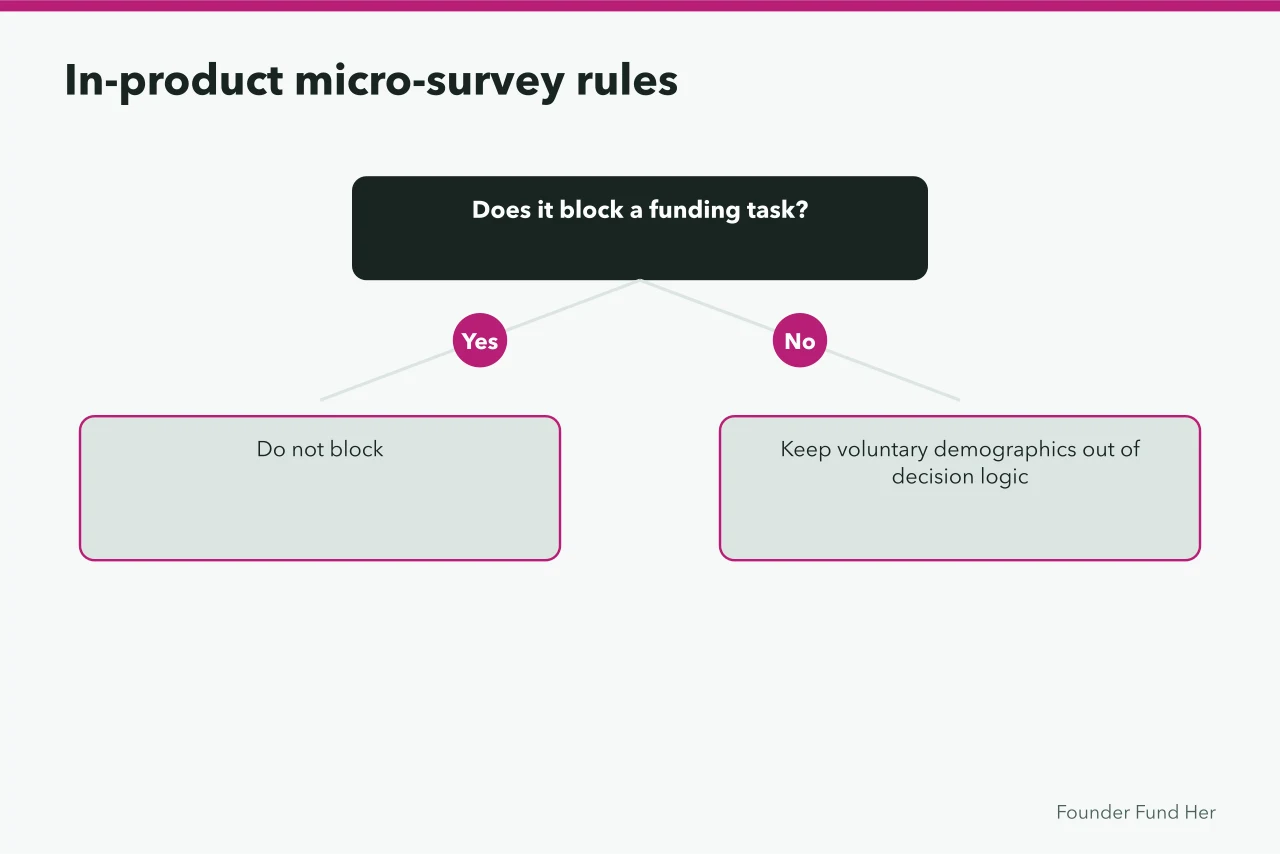
This captures immediate experience and can connect to behavioural data with an appropriate design. It misses non-users and people who left earlier. Do not block a funding task until the survey is completed, and keep voluntary demographic questions away from decision logic unless there is a documented reason.
Typical tools include Hotjar, Pendo, Typeform and Qualtrics. Paid plans are commonly published at roughly £25 to £100 per month, and basic tiers are often free. Adding and testing a micro-survey usually takes half a day to two days.
Structured spreadsheet or phone log
Best for: a small discovery pilot with careful manual quality control.
It is inexpensive and transparent, but permissions, validation and version control can fail quickly. Use fixed fields, participant IDs, an access list and a locked coding dictionary. Move to a governed system before volume makes manual mistakes hard to detect.
Common choices are Google Sheets, Excel and Airtable. Licence cost is near zero on existing accounts. Effort is the constraint, typically a day to build the template and a few hours a week on checks.
Sample size and recruitment across English regions
Set the sample target from the smallest subgroup you plan to report, not the total. A region-by-region comparison needs several hundred responses once screening and non-response are allowed for.
Recruit through channels that already hold England location data. Companies House holds director and registered office records, ONS UK Business Counts give regional business populations, and Beauhurst publishes funding data by region.
Funders and networks that reach women founders include Innovate UK's Women in Innovation programme, the British Business Bank's Start Up Loans, the Federation of Small Businesses and Enterprise Nation. Investing in Women Code signatories offer a further route.
Check how each channel is skewed before pooling responses.
Controls common to every tool
The Service Manual's research-data guidance covers planning collection, access, consent records, anonymisation and secure handling. The ICO's research provisions should be read with wider data-protection guidance because the correct basis and safeguards depend on purpose.
Write the analysis plan first. Define founder, route, period and England geography; allow "prefer not to say" where appropriate; separate missing from negative answers; and preserve the questionnaire version.
Pilot with people inside and outside the easiest recruitment network. Measure completion, skipped fields, clarification requests and device failures. Select the smallest tool that can meet the research question safely.
Run a procurement test
Create a dummy dataset containing optional demographic answers, a withdrawal request, a corrected response and no genuine financial details. Test role access, export, deletion, audit logs and supplier support. Confirm what happens when a subscription ends and whether data can be removed from backups under the documented process.
Ask the supplier to identify hosting and subprocessors rather than relying on a generic security badge. Review the contract against the research data map. A feature-rich platform is a poor choice if the team cannot configure it or honour a participant request.
Keep a second, accessible completion route for a pilot. Reconcile the two inputs under one identifier scheme and record mode effects instead of treating them as identical by default.
Before you act
- Define founder, route, period and England geography before collecting data.
- Write the analysis plan before launching any survey.
- Create a dummy dataset to test access, export and deletion.
- Ask the supplier to identify hosting and subprocessors.
Common questions
What are the main weaknesses of a hosted online questionnaire?
Self-selection, forwarding outside the sample and duplicate responses are the main threats. Poor connectivity and accessibility faults exclude some participants.
How can I reduce interviewer effects in an interviewer-administered survey?
Train interviewers, use a neutral script and keep advisers away from decisions on applications. Review completion and refusal patterns by interviewer, since variation there often signals an effect.
What should I check before using a panel survey for women founders?
Ask how business ownership and England location are verified, and request the number screened out. Compare the panel's composition with Companies House and ONS business counts before treating it as representative.